72-Hour Emergency Kit Checklist
A 72-hour kit (often called a go-bag or bug-out bag) is a set of supplies that lets your household get through about three days without power, running water or a trip to the store. Ready.gov recommends having food, water and other supplies to last for several days, and preparing supplies for home, work and the car. This checklist follows that guidance and adds a simple routine so the kit is still usable when you actually need it.
Why three days?
After a storm, flood or regional outage, help and normal services can take time to reach everyone. Ready.gov talks about "several days"; three days is a common, carryable baseline for a go-bag. For water, the CDC suggests at least 3 days and a 2-week supply at home if possible. Start with 72 hours, then build up.
The core checklist
These are the basic items Ready.gov lists for a household kit. Check each one off as you pack it.
- Water: one gallon per person per day for drinking and sanitation, so three gallons per person for 72 hours. (See our water storage guide for the math.)
- Food: at least a several-day supply of non-perishable food your household will actually eat, plus a manual can opener.
- Radio: a battery-powered or hand-crank radio, ideally one that receives NOAA Weather Radio alerts.
- Flashlight and extra batteries that fit everything in the kit.
- First aid kit.
- Whistle to signal for help.
- Dust masks, plus plastic sheeting, scissors and duct tape to shelter in place.
- Sanitation: moist towelettes, garbage bags and plastic ties.
- Wrench or pliers to turn off utilities.
- Local maps on paper, in case phones and GPS are down.
- Cell phone chargers and a backup battery.
Items that depend on your household
The basic list is the same for everyone. This second list is where most kits have gaps, because it depends on who lives with you.
- Prescription medications and any over-the-counter medicine you rely on, with a note of doses.
- Glasses or contact lenses and solution.
- Infant formula, bottles, diapers and wipes.
- Pet food, water, leash or carrier and medications (see the pet emergency kit checklist).
- Copies of important documents, such as insurance policies and identification, kept in a waterproof container or a secure, password-protected digital copy.
- Cash in small bills, since card readers and ATMs may not work.
- A change of clothes and sturdy shoes for each person, plus a sleeping bag or warm blanket.
- Feminine and personal hygiene supplies.
- Matches in a waterproof container and a fire extinguisher at home.
- Paper and pencil, and books, games or puzzles for children.
How to pack it so you can carry it
A kit that is too heavy to lift is a kit you will leave behind. A few habits help:
- Split by person. Give each adult or older child a bag with their own clothes, medication and a share of water and food. If one bag is lost, you have not lost everything.
- Weigh it. Water is the heaviest item by far: a US gallon weighs a little over 8 pounds. If you are evacuating by car, keep most of the water in the car or in a separate container rather than in backpacks.
- Use the same container every time. A labeled plastic bin or duffel near an exit is easier to grab than items spread across the house.
- Keep a printed list inside the bag. When you use something, cross it off so you know what to replace.
Find the gaps: "need" versus "packed"
The most useful way to check a kit is to compare two numbers for every item: how many you need and how many are actually packed. For example, if your household of three needs 9 gallons of water for 72 hours and you have 4 one-gallon jugs, the gap is 5 gallons. Doing this item by item shows exactly what to buy next, instead of buying more of what you already have.
| Item | Needed | Packed | Gap |
|---|---|---|---|
| Water (gallons, 3 days) | 9 | 4 | 5 |
| Flashlights | 3 | 1 | 2 |
| AA batteries | 12 | 16 | 0 |
| Dust masks | 3 | 0 | 3 |
Notice the batteries: having more than you need does not cancel out a shortage of something else. Count each item on its own.
Keep it ready: a twice-a-year routine
Ready.gov advises replacing expired items and rethinking your needs every year as your family changes. Checking twice a year, for example when the clocks change, keeps things fresher. At each check:
- Replace water you filled yourself about every six months, and check dates on store-bought water.
- Rotate food into your pantry before its date, and restock (our food rotation guide covers this).
- Test flashlights and the radio; replace batteries that are low or near their date.
- Check medication dates and update the list of doses.
- Swap children's clothes for the current size and season.
- Update documents and emergency phone numbers.
Common mistakes
- Buying a pre-made kit and never opening it. Pre-made kits are a fine start but rarely include medication, documents, pet supplies or enough water.
- Packing food nobody will eat. Stress is not the time to discover a food you dislike or cannot eat.
- Forgetting the car. A smaller kit in the car (water, snacks, blanket, flashlight, phone charger) covers the times you are away from home.
- No plan to go with the kit. Agree on a meeting place and an out-of-area contact so the kit is part of a plan, not just a bag.
Want this as a ready-made template?
Everything above works with pen and paper. If you would rather have the math done for you, these are our related templates. They are paid digital downloads on Etsy; check each listing for current price, file format and details.
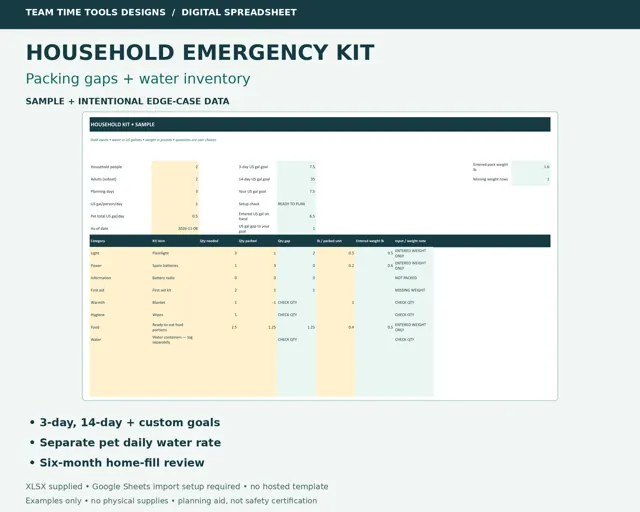
72-Hour Emergency Kit & Water Storage Planner
Compare what your kit plan needs with what is packed, see gaps, and keep a 50-container water log with 3-day, 14-day and custom water goals. XLSX for Excel or Google Sheets import.
View on Etsy : 72-Hour Emergency Kit & Water Storage Planner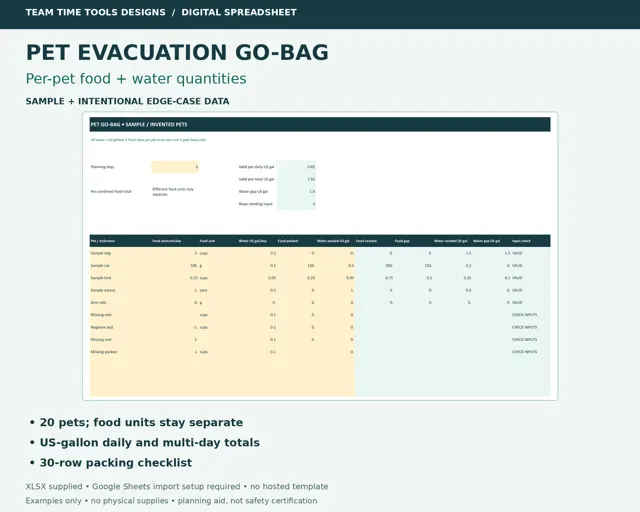
Pet Emergency Go-Bag Planner
Plan food, water and packing for several pets. Each pet keeps its own food unit, needs scale by days, and a checklist tracks what is packed. XLSX for Excel or Google Sheets import.
View on Etsy : Pet Emergency Go-Bag Planner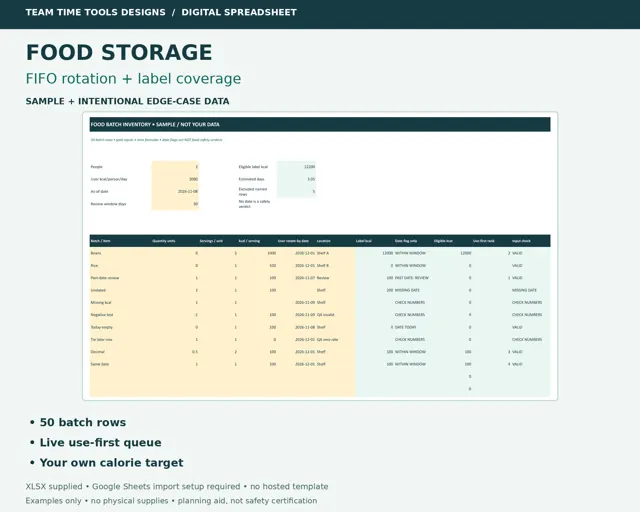
Emergency Food Storage & Rotation Spreadsheet
Log food batches with quantity, servings, label calories, your own rotate-by date and location. Builds a use-first (FIFO) queue and an estimated label-calorie coverage figure for your household. XLSX for Excel or Google Sheets import.
View on Etsy : Emergency Food Storage & Rotation SpreadsheetSources
This guide is general information, not professional advice. Rules and recommendations change; confirm with the official sources above.