Food Storage Rotation: A Simple FIFO System
Stocking up on food is the easy part. The hard part is using it before it goes stale, so you are not throwing money away or finding out in an emergency that half your supply is past its best. The answer is a rotation system, usually called FIFO: first in, first out. You eat the oldest food first and put new food behind it.
Rule 1: Store what you eat, eat what you store
Rotation only works if the food in storage is food your household eats every week. Rice, oats, pasta, canned beans, canned vegetables, peanut butter and canned fish are common choices because they are used in ordinary meals. A shelf of unfamiliar survival food that nobody wants to open will not rotate.
Rule 2: Every item gets a date
Write a date on everything with a marker when it comes home. You have two options:
- The date on the package ("best by" or "use by"), if it has one.
- Your own rotate-by date, which you choose so you use the item well before quality drops.
The USDA Food Safety and Inspection Service gives general guidance for shelf-stable food. For example, it says high-acid canned foods such as tomatoes and pineapple can generally be stored unopened for 12 to 18 months, and low-acid canned foods such as meat, fish and most vegetables for 2 to 5 years, if the cans stay in good condition and are stored in a cool, clean, dry place. Dates on most packaged foods are about quality, not safety, but a date is still the best tool you have for rotating in order.
Whatever date you use, it is a plan, not a guarantee. Throw out cans that are bulging, leaking, badly dented or rusted, and anything that smells or looks wrong.
Rule 3: Arrange shelves so the oldest is in front
- When you shop, move older items forward.
- Put new items behind them (or load from the top of a can rotation rack so the oldest rolls out first).
- Keep one kind of food in one place, so you can see how much you have.
- Store in a cool, dry, dark spot. Heat shortens shelf life; avoid spaces above the stove, next to the water heater or in a hot garage.
Rule 4: Track batches, not just items
If you buy 12 cans of beans in March and 12 more in August, they are two batches with different dates. Treat them separately. A batch list might look like this:
| Item | Qty left | Rotate by | Location |
|---|---|---|---|
| Black beans, 15 oz | 5 | 2027-04-30 | Pantry shelf 2 |
| Black beans, 15 oz | 12 | 2027-09-15 | Basement bin A |
| Rolled oats, 42 oz | 2 | 2027-02-01 | Pantry shelf 1 |
| Canned tuna | 8 | 2028-06-01 | Basement bin B |
Sort this list by rotate-by date and you have your use-first queue: the top rows are what to cook this month. Anything already past its date goes to a review pile for you to inspect, not straight onto the menu.
Rule 5: Know roughly how long it would last
"We have a lot of food" is hard to plan around. A better question is: about how many days would this feed us? A rough calorie estimate answers it:
Days of food ≈ total label calories ÷ (people × calories per person per day)
Total label calories for one batch = units × servings per unit × calories per serving (from the nutrition label). Add up all batches, then divide by your household's daily target. Choose that daily target yourself based on the people in your home; ages, sizes and activity levels vary, and this guide does not prescribe one.
Example: 120,000 label calories ÷ (3 people × 2,000 calories) ≈ 20 days. This is only a calorie estimate. It says nothing about nutritional balance, special diets, or whether you can cook the food without power, so plan those separately (think manual can opener, no-cook foods and a safe way to heat food).
A 15-minute monthly routine
- Pull the next items from the front of the queue into this month's meal plan.
- Check the review pile and discard anything damaged or spoiled.
- Restock what you used, writing the date on each new item, and put it at the back.
- Update your batch list and recalculate days of food.
Common mistakes
- Buying in one big haul. Everything then reaches its date at once. Build up a little each shopping trip instead.
- Storing in the wrong place. A hot garage or attic can shorten shelf life.
- No dates. Without dates, FIFO turns into guessing.
- Forgetting water. Many stored foods need water to prepare. Plan water separately (see how much water to store).
Want this as a ready-made template?
Everything above works with pen and paper. If you would rather have the math done for you, these are our related templates. They are paid digital downloads on Etsy; check each listing for current price, file format and details.
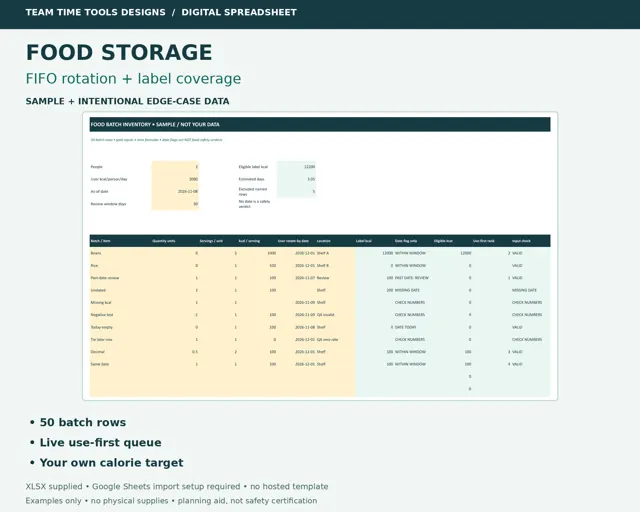
Emergency Food Storage & Rotation Spreadsheet
Log food batches with quantity, servings, label calories, your own rotate-by date and location. Builds a use-first (FIFO) queue and an estimated label-calorie coverage figure for your household. XLSX for Excel or Google Sheets import.
View on Etsy : Emergency Food Storage & Rotation Spreadsheet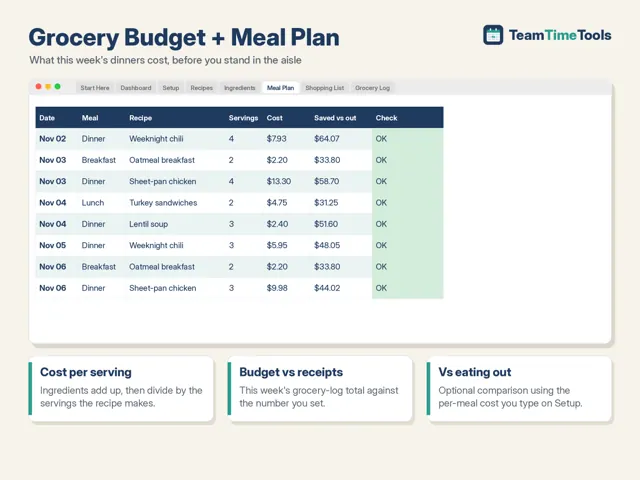
Grocery Budget & Meal Plan Cost Tracker
Ingredients roll up into recipe cost per serving, the meal plan multiplies by servings, and a dashboard compares the plan with your grocery budget. Excel and Google Sheets.
View on Etsy : Grocery Budget & Meal Plan Cost TrackerSources
This guide is general information, not professional advice. Rules and recommendations change; confirm with the official sources above.