How Much Water to Store for Emergencies
The short answer from Ready.gov and the CDC is: store at least one gallon of water per person per day, for drinking and basic sanitation. The CDC recommends at least a 3-day supply and, if possible, a 2-week supply. The rest of this guide shows how to turn that into a number for your household and how to keep the water fresh.
The basic formula
Water needed (gallons) = people × gallons per person per day × days
With the one-gallon baseline:
| Household | 3 days | 14 days |
|---|---|---|
| 1 person | 3 gal | 14 gal |
| 2 people | 6 gal | 28 gal |
| 4 people | 12 gal | 56 gal |
| 6 people | 18 gal | 84 gal |
One gallon is a minimum, not a cap. Ready.gov notes that children, nursing mothers and people who are sick may need more, and that a hot climate can double the amount a person needs. If any of that applies, raise the gallons-per-day number rather than adding extra people.
Don't forget pets
Pets need water too, and they are easy to leave out of the math. Pet needs vary a lot by species, size and activity, so ask your veterinarian for a daily amount and add it as a separate line:
Total = (people × gallons per person per day + total pet gallons per day) × days
Keep pets as their own line instead of counting them as people. A small cat needs far less than a person; a large working dog in hot weather may need more than you expect. Our pet emergency kit checklist covers the rest of a pet go-bag.
Worked example
A household of 4 people and one dog, planning for 14 days at home. They choose 1 gallon per person per day and the vet suggests about a quarter gallon a day for the dog (illustration only):
- People: 4 × 1 × 14 = 56 gallons
- Dog: 0.25 × 14 = 3.5 gallons
- Total: 59.5 gallons, or about 60 one-gallon jugs, twelve 5-gallon containers, or one 55-gallon drum plus a few jugs.
The same household needs about 12.75 gallons for a 3-day evacuation kit. That is over 100 pounds of water, so most of it belongs in the car or at home, not in backpacks.
Store-bought or fill your own?
Store-bought bottled water is the simplest option. Keep it in its original sealed container and watch the date on the label.
Filling your own containers is cheaper. The CDC recommends food-grade water storage containers, cleaned and sanitized before filling, and replacing home-filled water about every six months. Avoid containers that held milk or fruit juice, which are hard to clean fully, and never use containers that held chemicals.
Where to keep it
- In a cool, dark place, away from direct sunlight.
- Away from gasoline, pesticides and other chemicals; plastic can absorb vapors.
- Spread across more than one location if you can (for example, a closet and the garage) so one problem doesn't take it all.
- With labels: "Drinking water" and the date filled or the date on the package.
Keep a container log
Once you have more than a few containers, it gets hard to remember which ones are due. A simple log solves it. For each container, note:
- Container label or number
- Size in gallons
- Store-bought or home-filled
- Date filled (home-filled) or date printed on the label (store-bought)
- Location
- Next review date (about six months after filling for home-filled water)
Add up the gallons in the log and compare the total with your 3-day and 14-day goals. That tells you at a glance whether you are short and by how much.
If you run short
Water in your water heater and ice cubes are usable sources in an emergency. If you need to treat water, follow the CDC's instructions on boiling or disinfecting, and only use water you have a safe way to treat. Ready.gov advises not to ration drinking water unless authorities tell you to: drink the amount you need today and try to find more for tomorrow.
Quick checklist
- Count people, decide gallons per person per day (1 minimum, more in heat or for nursing/sick household members).
- Add a separate daily amount for each pet.
- Calculate a 3-day and a 14-day total.
- Buy or fill food-grade containers; label them with the date.
- Store cool, dark and away from chemicals.
- Review home-filled water about every six months.
Want this as a ready-made template?
Everything above works with pen and paper. If you would rather have the math done for you, these are our related templates. They are paid digital downloads on Etsy; check each listing for current price, file format and details.
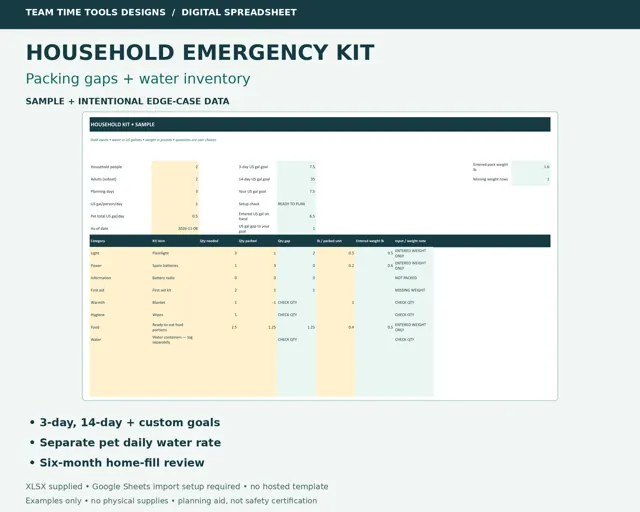
72-Hour Emergency Kit & Water Storage Planner
Compare what your kit plan needs with what is packed, see gaps, and keep a 50-container water log with 3-day, 14-day and custom water goals. XLSX for Excel or Google Sheets import.
View on Etsy : 72-Hour Emergency Kit & Water Storage Planner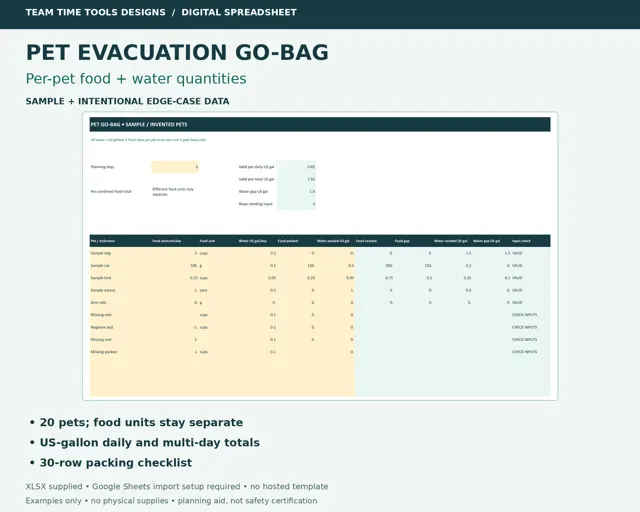
Pet Emergency Go-Bag Planner
Plan food, water and packing for several pets. Each pet keeps its own food unit, needs scale by days, and a checklist tracks what is packed. XLSX for Excel or Google Sheets import.
View on Etsy : Pet Emergency Go-Bag PlannerSources
This guide is general information, not professional advice. Rules and recommendations change; confirm with the official sources above.