How to Price House Cleaning Jobs
Many new cleaning businesses price by copying a competitor or guessing a round number. The problem is that a price that looks fine can lose money once you count everyone's hours, supplies and driving. This guide gives a simple formula built from your own costs, then shows how to check it against real jobs.
Step 1: Know your labor cost per hour
Labor is the biggest cost in cleaning. Start with the hourly wage you pay a cleaner, or the hourly amount you want to pay yourself. If you have employees, add employer costs such as payroll taxes and workers' compensation insurance; your payroll provider or accountant can tell you roughly what that adds.
Step 2: Estimate hours for the job
Estimate total labor hours, not clock hours. Two cleaners working 2 hours is 4 labor hours. Things that change hours:
- Square footage, bedrooms and bathrooms
- Standard clean vs deep clean vs move-in/move-out
- Pets, clutter and how recently the home was cleaned
- Extras: inside the oven or fridge, interior windows, laundry
A walkthrough or photos before quoting help you avoid surprises.
Step 3: Add supplies
Estimate the cost of products, cloths, mop heads, gloves and bags used per job. It's usually small per visit, but it adds up over hundreds of jobs.
Step 4: Apply your target margin
Your margin has to cover overhead (insurance, phone, software, advertising, vehicle costs, unpaid time spent quoting and driving) and leave a profit.
Price = (labor hours × hourly wage + supplies) ÷ (1 − target margin)
Example (illustration only): 3.5 labor hours × $25 wage = $87.50, plus $6 supplies = $93.50. With a 30% target margin: $93.50 ÷ 0.70 = $133.57, which you might round to $135.
Margin is not markup
Adding 30% to cost ($93.50 × 1.30 = $121.55) is a 30% markup, but only about a 23% margin on the selling price. Dividing by (1 − margin) gives the margin you actually intended.
Flat rate, hourly or per square foot?
| Method | Good for | Watch out for |
|---|---|---|
| Flat rate per visit | Recurring clients; easy for customers to understand | Jobs that run long eat your profit |
| Hourly | Unpredictable jobs, first deep cleans | Customers can't predict the bill |
| Per square foot / per room | Quick quotes at scale | Ignores condition and clutter |
Many cleaners quote the first deep clean hourly or at a higher flat rate, then offer a lower flat rate for recurring visits once they know the home.
Step 5: Check quoted vs actual hours
This is the step most businesses skip. For every job, record the hours you quoted and the hours you actually worked. Your real labor cost is actual hours × wage, not the quote.
| Client | Quoted hrs | Actual hrs | Price | Labor cost |
|---|---|---|---|---|
| A | 3.0 | 3.0 | $115 | $75 |
| B | 3.0 | 4.5 | $115 | $112.50 |
Client B looks like the same job on paper, but nearly all of the price goes to labor. If a client runs long every time, adjust their price or the scope.
Don't forget the money side
- Send an invoice or receipt for every job and track who still owes you.
- Count unpaid jobs as costs until they're paid, so your profit isn't overstated.
- Track expenses (supplies, mileage, insurance) month by month.
- If you're self-employed, set aside a percentage of every payment for taxes (see estimated taxes).
- Review prices at least once a year as wages and supply costs change.
Want this as a ready-made template?
Everything above works with pen and paper. If you would rather have the math done for you, these are our related templates. They are paid digital downloads on Etsy; check each listing for current price, file format and details.
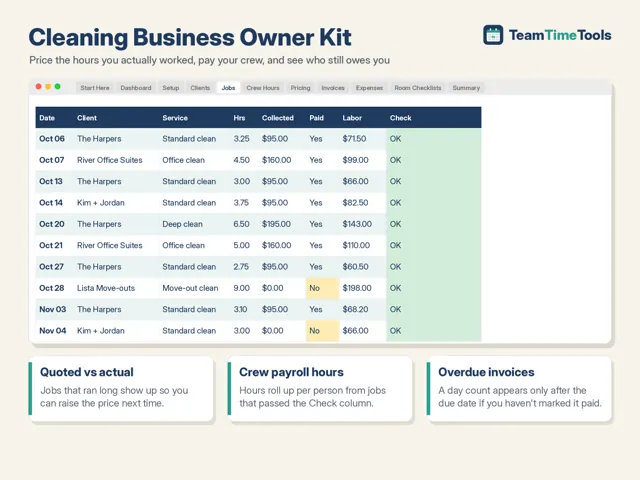
Cleaning Business Owner Kit
Jobs, quoted vs actual hours, crew hours, a pricing calculator, invoices, expenses and room checklists for house cleaners and small cleaning teams. Excel and Google Sheets.
View on Etsy : Cleaning Business Owner Kit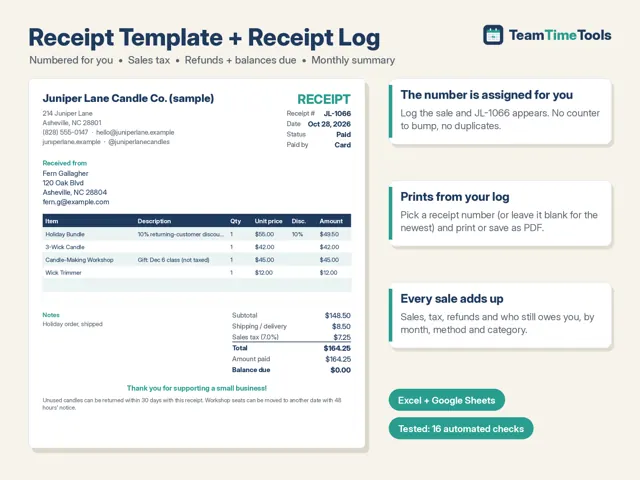
Receipt Template & Receipt Log
Auto-numbered printable receipts, sales tax worked out, and a sales log that totals by month. Excel and Google Sheets.
View on Etsy : Receipt Template & Receipt LogSources
- U.S. Small Business Administration: Calculate your startup costs
- IRS: Self-Employed Individuals Tax Center
This guide is general information, not professional advice. Rules and recommendations change; confirm with the official sources above.