Quarterly Estimated Taxes for Freelancers (2027)
When you work for yourself, nobody withholds tax from your pay. The IRS expects you to pay during the year through quarterly estimated tax payments. This guide covers the 2027 due dates, how self-employment tax works, the safe harbor rules that help you avoid an underpayment penalty, and a simple way to set money aside. It is general information, not tax advice; for your situation, see IRS Form 1040-ES or a tax professional.
Who needs to pay estimated tax?
In general, the IRS says you should make estimated payments if you expect to owe at least $1,000 in federal tax for the year after subtracting withholding and refundable credits. Many freelancers, gig workers and small business owners fall into this group. Your state may have its own estimated tax rules.
2027 due dates (tax year 2027)
| Payment | Covers income earned | Due date |
|---|---|---|
| 1st | Jan 1 – Mar 31, 2027 | April 15, 2027 |
| 2nd | Apr 1 – May 31, 2027 | June 15, 2027 |
| 3rd | Jun 1 – Aug 31, 2027 | September 15, 2027 |
| 4th | Sep 1 – Dec 31, 2027 | January 18, 2028* |
*January 15, 2028 falls on a Saturday and Monday, January 17, 2028 is Martin Luther King Jr. Day, so the deadline moves to the next business day. Always confirm dates on the current Form 1040-ES, since the IRS can change deadlines (for example, for disaster relief). Note the quarters are not equal in length.
How self-employment tax works
Self-employment (SE) tax is Social Security and Medicare tax for people who work for themselves. It's calculated on Schedule SE:
- Start with net profit from your business (income minus business expenses).
- Multiply by 92.35% to get net earnings from self-employment.
- Apply 12.4% for Social Security (up to that year's Social Security wage base) and 2.9% for Medicare, for 15.3% total. An extra 0.9% Medicare tax can apply above certain income levels.
Example (illustration only): $40,000 net profit × 92.35% = $36,940; × 15.3% = about $5,652 of SE tax. You can deduct half of SE tax when calculating income tax. SE tax generally applies if your net earnings from self-employment are $400 or more.
Income tax comes on top of SE tax. It depends on your filing status, deductions and other income, so many freelancers use a rough rate based on last year's return for planning.
Safe harbor: avoiding the underpayment penalty
You generally avoid the federal underpayment penalty if your withholding and timely estimated payments add up to at least the smaller of:
- 90% of the tax shown on your current-year return, or
- 100% of the tax shown on your prior-year return (110% if your prior-year adjusted gross income was more than $150,000, or $75,000 if married filing separately). The prior year must have been a full 12-month tax year with a return filed.
The prior-year rule is popular with freelancers whose income grows, because you know the number in advance: divide it by four and pay that each quarter.
A simple set-aside method
- Open a separate savings account just for taxes.
- Pick a percentage to move from every client payment. A rough starting point is SE tax (about 14.1% of net profit, since 15.3% × 92.35%) plus your expected income tax rate, adjusted for your expenses. Refine it after your first quarter.
- Move the money the day you're paid. Don't wait for the quarter.
- Track income and expenses monthly so your profit estimate stays current.
- Pay each quarter through IRS Direct Pay, your IRS Online Account or EFTPS, and record the date and amount.
Records to keep
- Every invoice and payment received
- Business expenses with receipts
- Business mileage, if you deduct vehicle use
- Each estimated payment: date, amount and confirmation number
- Last year's total tax (for the safe harbor calculation)
Good records make the year-end return faster and help you adjust payments mid-year if income changes.
Want this as a ready-made template?
Everything above works with pen and paper. If you would rather have the math done for you, these are our related templates. They are paid digital downloads on Etsy; check each listing for current price, file format and details.
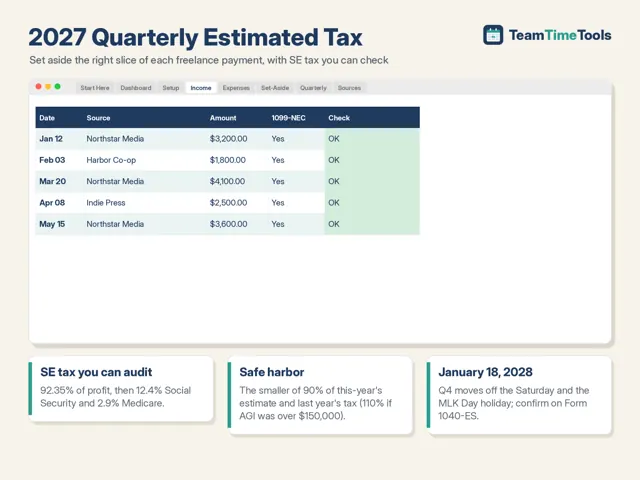
Freelancer Quarterly Estimated Tax 2027
Estimates self-employment tax, a rough income-tax figure at the rate you choose, quarterly amounts and a suggested set-aside percent from each payment. Excel and Google Sheets.
View on Etsy : Freelancer Quarterly Estimated Tax 2027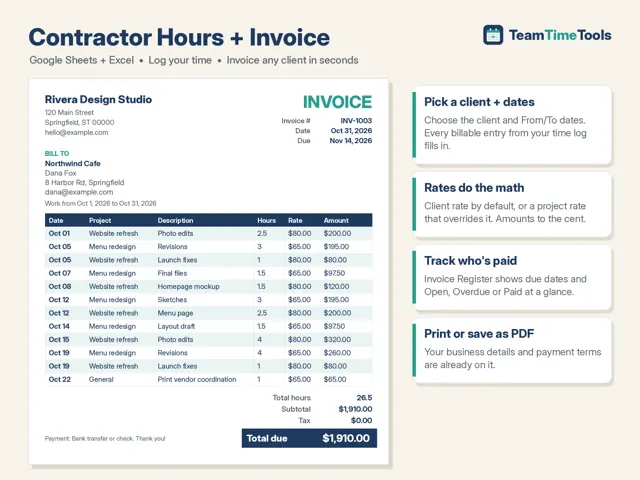
Freelance Hours Log & Invoice Template
Log hours by client and project; pick a client and date range and the invoice fills in. Tracks what has been paid. Excel and Google Sheets.
View on Etsy : Freelance Hours Log & Invoice Template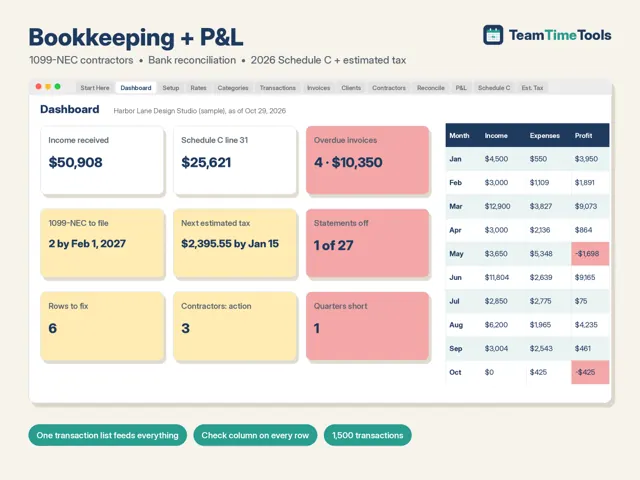
Small Business Bookkeeping & P&L Spreadsheet
One transaction list becomes a 12-month profit and loss and Schedule C summary, with bank reconciliation and invoice aging for a one-owner service business. Excel and Google Sheets.
View on Etsy : Small Business Bookkeeping & P&L SpreadsheetSources
This guide is general information, not professional advice. Rules and recommendations change; confirm with the official sources above.