Rotating Shift Schedules Explained
A rotating shift schedule moves crews through a repeating pattern of work days and days off so a 24/7 operation is always covered. Hospitals, plants, warehouses, security, dispatch and fire departments all use them. This guide explains the most common patterns, how many crews each needs, and what they mean for weekly hours and overtime.
The basic math of 24/7 coverage
A week has 168 hours. If one position must be filled around the clock, those 168 hours are shared among your crews. The average weekly hours per person depend on how many crews share them:
| Crews | Average hours per person per week |
|---|---|
| 3 | 56 |
| 4 | 42 |
| 5 | 33.6 |
That's why most 12-hour 24/7 schedules use four crews: they average 42 hours a week, close to a standard 40.
2-2-3 (often called the Panama schedule)
- Shift length: 12 hours
- Crews: 4 (two on days, two on nights, alternating)
- Pattern: work 2 days, off 2, work 3, off 2, work 2, off 3, repeating every 14 days.
- Result: every other weekend is a 3-day weekend. Over each 14-day cycle a person works 7 shifts (84 hours), averaging 42 hours a week. How those hours split between workweeks depends on the day your workweek starts: it can be 36 and 48, or as uneven as 60 and 24.
Names vary between workplaces; some call 2-2-3 the "Pitman" schedule. Always define the pattern by its days on and off.
DuPont
- Shift length: 12 hours
- Crews: 4
- Pattern (28-day cycle): 4 nights on, 3 off, 3 days on, 1 off, 3 nights on, 3 off, 4 days on, then 7 days off.
- Result: a full week off every four weeks, but some weeks are heavy and the switch between days and nights is frequent.
4-on, 4-off
- Shift length: 12 hours; crews: 4
- Pattern: 4 days on, 4 off, on an 8-day cycle, so days off fall on a different weekday each cycle.
24/48 (24 on, 48 off)
- Shift length: 24 hours
- Crews: 3 (often called A, B and C shift)
- Pattern: one 24-hour shift, then two days off, every 3 days.
- Result: about 56 hours per week on average. Common in fire departments.
Overtime: the part to check before you choose
Under the federal Fair Labor Standards Act, non-exempt employees generally get overtime at 1.5 times their regular rate for hours over 40 in a workweek. Because rotating patterns put different hours into different weeks, two patterns with the same 42-hour average can produce different overtime. In the 2-2-3 example, if the weeks split 36 and 48 hours, there are 8 overtime hours every two weeks (about 4 a week). If the same pattern splits 60 and 24, there are 20 overtime hours every two weeks (about 10 a week), for exactly the same schedule.
- Your workweek start day changes which shifts fall into which week, and therefore the overtime.
- Some states, such as California, also have daily overtime rules.
- Public-agency fire protection and law enforcement employers may use special FLSA work periods of 7 to 28 days under section 7(k) (see DOL Fact Sheet #8).
- Holidays and premium pay depend on your policy or contract.
Before adopting a pattern, lay out a full year for each crew and add up hours by workweek. That shows the real overtime cost and who's short when people take leave.
Choosing a pattern: checklist
- How many positions need covering, and for how many hours a day?
- 8-, 10-, 12- or 24-hour shifts? Consider fatigue, commute and safety.
- How many crews, and how many people per crew including leave coverage?
- Fixed or rotating days and nights?
- Weekly hours and overtime by workweek for a full year
- Holiday coverage and premium pay rules
- How employees will see their schedule and request time off
Want this as a ready-made template?
Everything above works with pen and paper. If you would rather have the math done for you, these are our related templates. They are paid digital downloads on Etsy; check each listing for current price, file format and details.
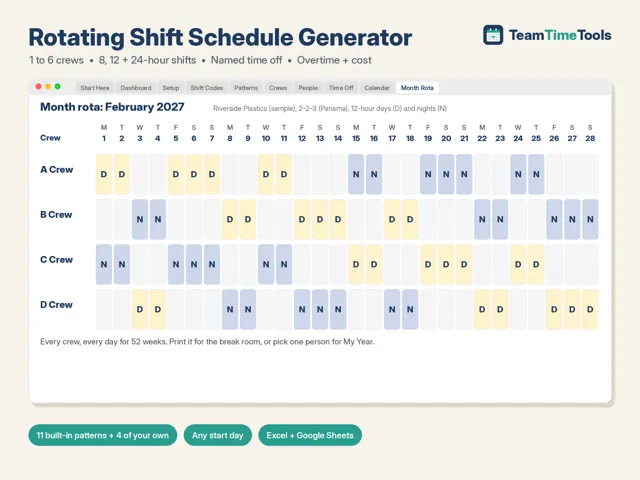
Rotating Shift Schedule Generator
A year of rotating shifts for every crew (2-2-3, DuPont, Panama, 24/48 and more), coverage gaps when people take leave, and overtime by pattern. Excel and Google Sheets.
View on Etsy : Rotating Shift Schedule Generator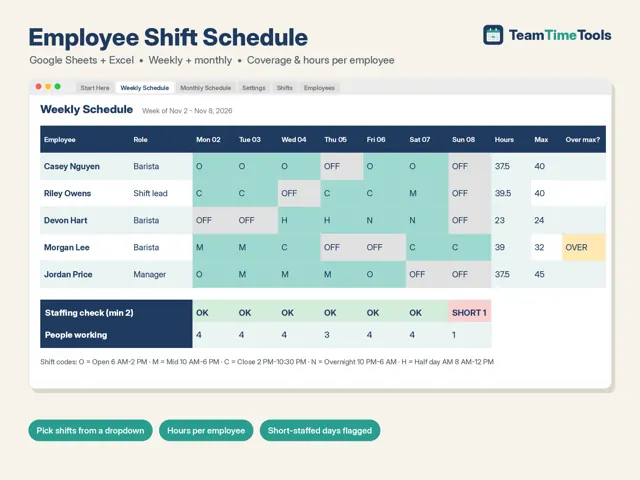
Employee Shift Schedule
Weekly and monthly schedules from your own shift codes, paid hours per person and flags for days below minimum staffing. Excel and Google Sheets.
View on Etsy : Employee Shift Schedule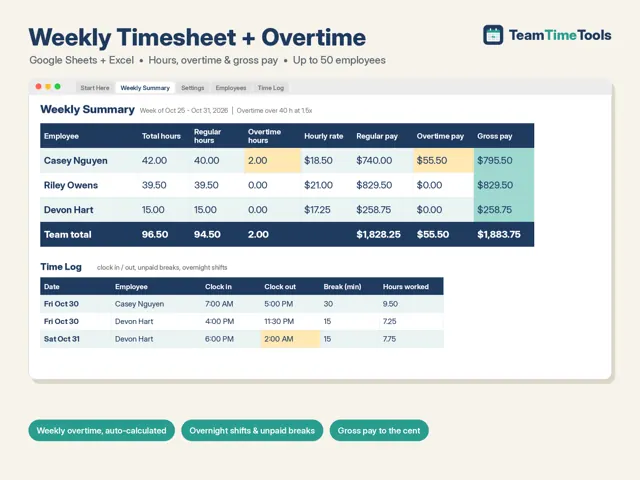
Weekly Timesheet & Overtime Calculator
Clock-in and clock-out with unpaid breaks and overnight shifts; weekly overtime and gross pay per employee. Weekly overtime only (not daily overtime rules). Excel and Google Sheets.
View on Etsy : Weekly Timesheet & Overtime CalculatorSources
- U.S. Department of Labor: Overtime Pay
- U.S. Department of Labor: Fact Sheet #8, Law Enforcement and Fire Protection under the FLSA
This guide is general information, not professional advice. Rules and recommendations change; confirm with the official sources above.